
Cat Nighttime Zoomies: Why They Happen and What Your Cat’s Energy Is Telling You
5min read
Credit: Thrive & Purr
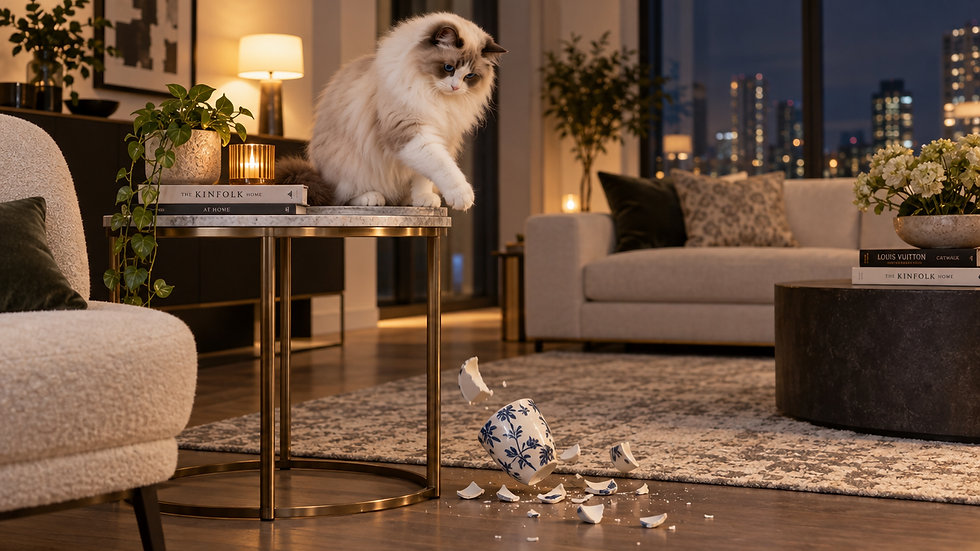
Your cat tears down the hallway at 1:30 a.m., launches off the couch, knocks something off the nightstand, and then looks at you as if you are the one who interrupted the evening.
If this sounds familiar, you are not alone. Cat nighttime zoomies are one of those indoor-cat behaviors that can be funny for about thirty seconds and exhausting after that.
The important thing is that nighttime activity is not automatically a behavior problem.
Cats are naturally most alert around dawn and dusk, and an indoor cat who has spent much of the day sleeping may simply become ready to move, explore, hunt, and interact when the house finally becomes quiet.
But recurring nighttime chaos can also be useful information.
Sometimes your cat is telling you that the day did not provide enough opportunities for movement, hunting, exploration, social connection, or mental engagement.
Other times, the pattern has become learned: your cat discovered that running, crying, scratching, or waking you eventually produces something interesting.
The goal is not to eliminate your cat's natural energy. It is to understand why your cat is awake at night and what that behavior may be communicating.
Why Do Cats Get the Zoomies at Night?
Despite the common idea that cats are nocturnal, domestic cats are generally more active around dawn and dusk.
Those periods naturally align with the activity patterns of potential prey.
That becomes important in an indoor environment.
A cat can spend eight or ten hours sleeping while the household is working, studying, or away. Then dinner happens, the lights come on, people return home, and suddenly there is an entire unused reserve of physical and mental energy.
For some cats, that energy comes out as a five-minute sprint around the living room.
For others, it becomes a nightly production involving hallway races, furniture launches, vocalizing, ankle attacks, or persistent attempts to get someone out of bed.
The behavior may look random from the human side of the relationship. From the cat's perspective, it can make perfect sense.
Your cat's body and brain are still looking for opportunities to do cat things: stalk, chase, climb, investigate, observe, eat, groom, and settle.
When those opportunities are limited during the day, nighttime may become the most obvious time to express them.
Cat Nighttime Zoomies Can Be a Form of Communication
One of the most useful shifts a cat parent can make is to stop looking at nighttime behavior only as an inconvenience.
A sudden burst of energy may be communicating "I need to move."
Repeated yowling may be communicating "I want interaction."
Pouncing on your feet may be communicating "I am looking for something to chase."
Repeated trips to the food bowl may be communicating "Food has become the most interesting event in my day."
That does not mean every nighttime behavior has one simple explanation. Cats are individuals, and the same behavior can have different causes.
It does mean the behavior is worth observing rather than immediately correcting.
Indoor-cat enrichment works best when it gives normal feline instincts somewhere appropriate to go.
When Nighttime Energy Is Normal—and When It Deserves Attention
Not every cat running through the house at midnight is bored or distressed.
A healthy young cat may simply have a tremendous amount of energy. Some cats are naturally more active than others.
Kittens and adolescents, in particular, can seem to have an almost unlimited supply of enthusiasm.
The context matters.
If your cat has a brief burst of running, plays normally, eats normally, uses the litter box normally, and settles afterward, the behavior may simply be part of their natural activity pattern.
More concerning is a new or significant change in nighttime behavior.
Watch for nighttime activity accompanied by:
Sudden or persistent vocalizing
Changes in appetite or thirst
Changes in litter box habits
Increased hiding
Unusual aggression
Restlessness that seems difficult to interrupt
Major changes in grooming
Changes in activity level in an older cat
Behavior cannot diagnose a medical problem by itself. Pain, illness, age-related changes, and other physical issues can sometimes appear first as changes in nighttime behavior.
If the pattern is sudden, intense, or accompanied by other changes in your cat's normal behavior, a conversation with your veterinarian is appropriate.
For a healthy cat with an established pattern of evening or nighttime energy, however, the question often becomes behavioral rather than medical:
What is happening during the day that might be setting up the night?
Why a Basket Full of Toys May Not Stop Cat Nighttime Zoomies
This is where many loving cat parents get frustrated.
You buy the toys: Your cat ignores them.
You buy different toys: Your cat becomes fascinated with the cardboard box they arrived in.
Then, at 2 a.m., your cat decides the bedroom door is the greatest enrichment object ever created.
The problem is not necessarily a lack of toys.
Cats are not simply looking for objects to interact with.
They are looking for experiences that allow them to express natural behaviors.
A toy sitting motionless on the floor does very little for a cat who wants to stalk something that moves.
A puzzle that is too difficult may create frustration rather than satisfaction.
A climbing structure in an area your cat never visits may be technically enriching but practically irrelevant.
And ten different toys available all the time can eventually become visual background noise.
What matters is not how much enrichment you own.
It is whether your cat actually finds meaningful opportunities to move, investigate, solve, choose, and recover.
That distinction is especially important for indoor cats because their environment is also their entire territory.
The Hunt Matters More Than the Toy
A satisfying play experience is about more than waving something in front of your cat.
Think about what makes hunting interesting to a predator.
There is anticipation.
Observation.
Movement.
A pause.
A chase.
A successful capture.
Then, eventually, recovery.
That sequence is part of what makes interactive play meaningful.
A feather wand can be exciting, but simply moving it continuously may not provide the same experience as allowing a cat to watch, stalk, pursue, and occasionally succeed.
The same principle explains why some cats become bored with toys quickly. The object itself was never the entire attraction. The behavior surrounding it was.
This is also why different cats can respond so differently to the same enrichment.
One cat may love fast-moving toys.
Another may prefer something that disappears around a corner.
A confident cat may enjoy climbing and chasing.
A cautious cat may prefer observing from a protected location before participating.
There is no universal "best cat toy."
There is the type of engagement that makes sense for the particular cat in front of you.
Daytime Enrichment Can Change the Nighttime Picture
One of the biggest misunderstandings about cat nighttime zoomies is the assumption that the solution has to happen immediately before bed.
Sometimes the real issue started much earlier.
A cat who slept almost uninterrupted all afternoon may simply have a lot of energy left when you want to go to sleep.
A cat who had little environmental stimulation may become intensely interested in every sound outside the window once the house gets quiet.
A cat who has spent the day with limited social interaction may suddenly demand attention when you finally sit down.
And a cat living with another cat may be experiencing subtle resource tension that becomes more obvious during the quieter nighttime hours.
This is why enrichment is bigger than play.
It includes the physical environment, opportunities for movement, mental stimulation, social connection, food-related engagement, and places where a cat can retreat and feel secure.
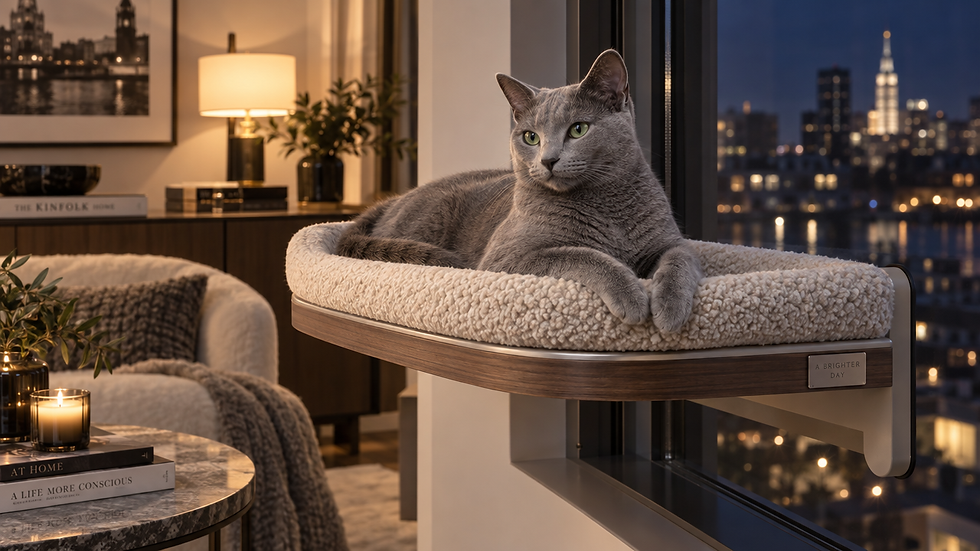
A healthy indoor environment gives a cat more than somewhere comfortable to sleep. It gives them appropriate ways to be a cat throughout the day.
Your Cat May Need Less Stimulation, Not More
There is another side to the nighttime-zoomies problem that is easy to overlook.
More activity is not always better.
Some cats become overstimulated by frantic play, excessive noise, constant access to exciting visual stimuli, or an environment that never seems to settle.
A cat who is already highly aroused may not need another round of intense activity. They may need a predictable transition toward quiet.
This is where rest becomes part of enrichment.
A comfortable resting location, a familiar environment, appropriate access to water and litter facilities, and the ability to retreat from household activity can all contribute to a sense of security.
Some cats prefer elevated resting places where they can observe the room.
Others want an enclosed, quiet space.
Some want to sleep beside you.
Others want to be completely left alone.
The important clue is often where your cat naturally chooses to rest when they have a choice.
The Midnight Reaction Can Become Part of the Problem
There is one more piece that many exhausted cat parents understandably miss.
Cats learn from outcomes.
If yowling at 3 a.m. reliably produces food, conversation, play, a door opening, or even an angry response, your cat may discover that nighttime behavior gets results.
From your perspective, you are trying to make the noise stop.
From your cat's perspective, the behavior worked.
This does not mean you should ignore your cat's needs or punish nighttime behavior.
It means the response itself can become part of the pattern.
The more useful question is: What does my cat consistently receive after this behavior happens?
And then: What might my cat actually be trying to obtain?
Food?
Movement?
Attention?
Access?
Security?
Stimulation?
The answer will not always be obvious, which is why observing the pattern is often more useful than reacting to each individual episode.
Look at the Pattern, Not Just the 2 A.M. Sprint
If your cat regularly wakes you at night, pay attention to what happened during the hours before it.
Was the day unusually quiet?
Was dinner earlier than usual?
Did you miss an interaction your cat normally expects?
Was there a visitor?
Did another pet interfere with access to a favorite space?
Did your cat spend the entire afternoon asleep?
Did something outside the window create unusual excitement?
Patterns become much easier to see when you stop treating each nighttime episode as an isolated event.
You may discover that the "nighttime problem" is actually a daytime enrichment problem.
Or a feeding-pattern problem.
Or an environmental problem.
Or simply a cat whose natural activity cycle does not yet fit comfortably with the household's schedule.
That distinction matters because the most useful response is rarely another isolated trick.
It is understanding how the pieces of your cat's day influence one another.
So How Do You Create Calmer Nights Without Fighting Your Cat's Nature?
Understanding why cats get nighttime zoomies is the first step.
The harder part is turning that understanding into a rhythm that fits your cat, your home, and your actual life.
That is where many owners get stuck. They understand that their cat needs play, enrichment, movement, food, rest, and security—but they are left wondering how to organize those needs consistently without creating another complicated chore.
A structured approach can provide that missing bridge.
Ready to Create Calmer Nights for Your Indoor Cat?
Understanding why your cat gets nighttime zoomies is the first step. The harder part is turning that understanding into a rhythm that fits your cat, your home, and your actual life.
If you're ready to move from understanding the behavior to building a more consistent approach at home, the Thrive & Purr: The Modern Indoor Cat Wellness System was created for cat parents who want more than scattered advice.
It brings the bigger picture together into a practical approach designed to help you understand your cat's needs, build consistency, and feel more confident about what you are doing day after day.
Because the goal is not a perfectly silent house.
It is the reassurance of knowing your cat's natural needs have a meaningful place in everyday life.


Comments